The Central Extremadura batholith
An example of pluton emplacement in a shear-related tectonic environment

The Central Extremadura batholith
An example of pluton emplacement in a shear-related tectonic environment
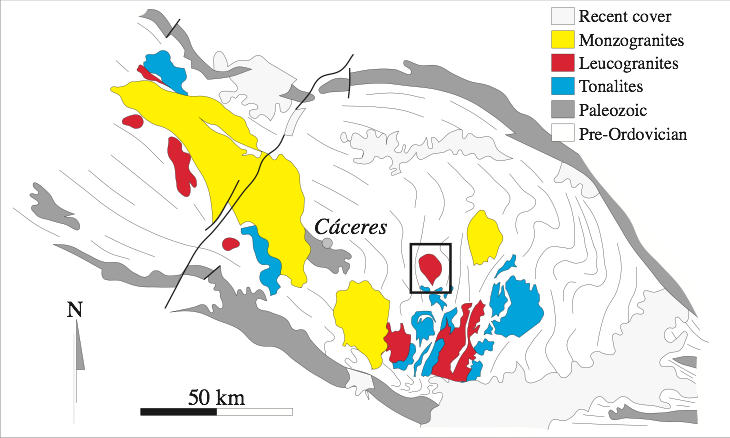
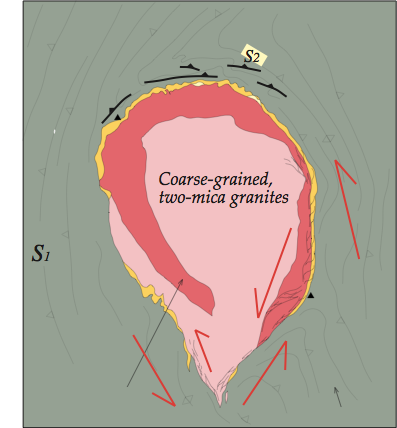
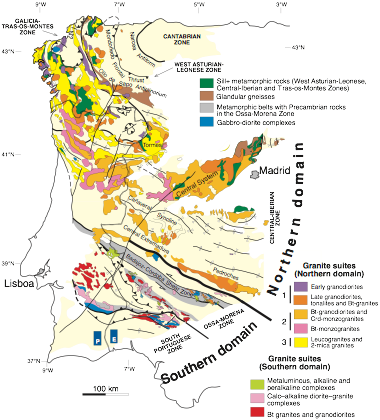
The Plasenzuela pluton in the Central Extremadura batholith in the southern Iberian Massif, is an example of permissive emplacement in relation to the tectonic development of extensional fractures in the upper continental crust. Paradoxically, this pluton has a concordant structural pattern which is classically attributed to diapirism or ballooning. This pattern consists of the following elements: (a) nearly elliptical shape in the horizontal section; (b) conformity of the pre-existing aureole structures to the shape of the pluton contacts; and (c) development of a crenulation cleavage, parallel to the contacts, in the vicinity of the pluton walls. All these features have been interpreted in many plutons as resulting from the pushing-aside of the country rock structures due to the expansion of the pluton. However, the detailed structural relationships in the aureole do not favour a forceful emplacement mechanism. By contrast, these relationships constitute prime evidence of permissive intrusion in extensional fractures. According to this interpretation, the concordant shape of the pluton was acquired by syn-plutonic opening of a mixed tensional-shear fracture, parallel to the main foliation in the host rocks, and by folding of the fracture walls together with the previous anisotropy of the country rocks. This is a growth±deformation process that can operate at local conditions in the upper continental crust giving rise to concordant syn-tectonic plutons.
Castro, A. and Fernández, C.
Journal of Structural Geology, Vol. 20, No. 9/10, pp. 1219 to 1228, 1998

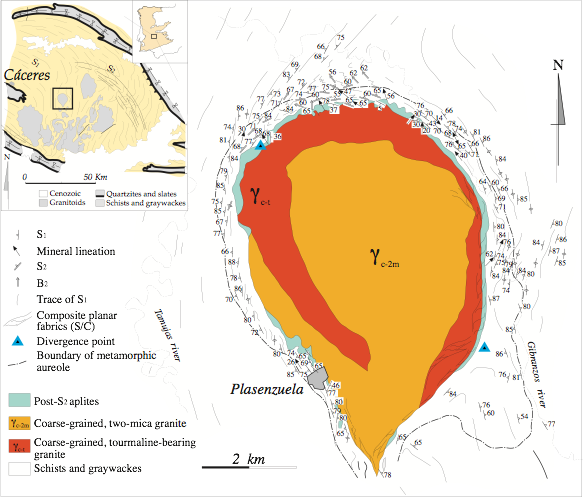
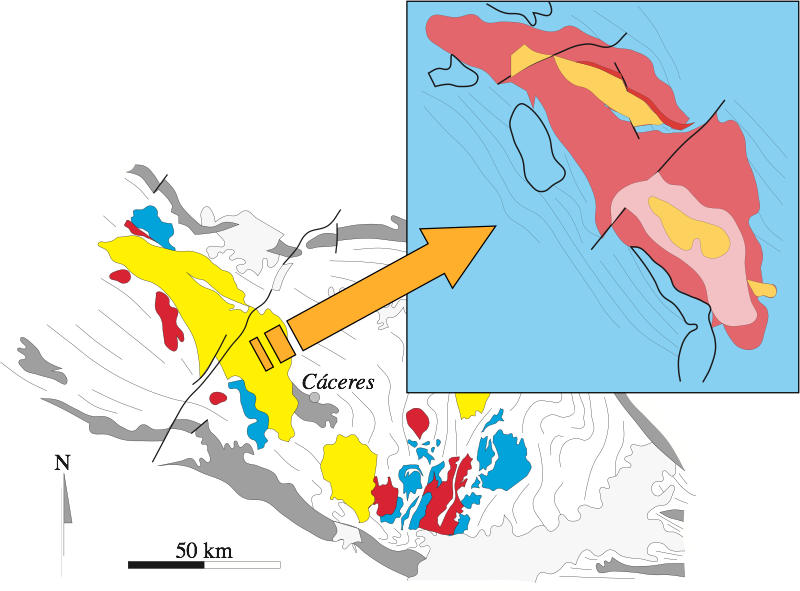
Aerial photograph and geological outline of the Plasenzuela pluton

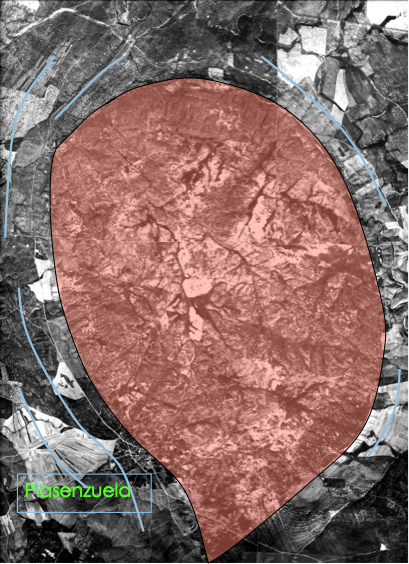


Is this pluton a diapir? The observed structures differ considerably from those expected to be formed in a diapir (see below), deforming the country rocks to accommodate the space occupied by the granite magma (see below). The three question marks point to three relevant point of the structure. One is the change in the contact orientation at the NW margin. The second is the acute tip of the South margin. And the third is the strongly foliated (shear zone) localized at the East margin.
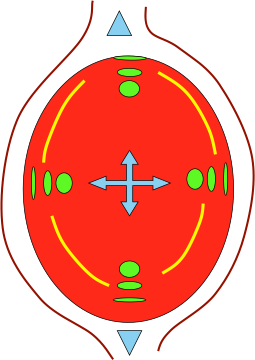
Typical structures of a diapir
Mapping of structures in the aureole reveals important information about the mechanism of pluton accommodation and emplacement. The internal structure is not provided. With the exception of the shear zone located at the East margin and close to the South tip, the granite is isotropic. Only local orientations of K-feldspar megacrysts are observed in local areas where megacrystas are present. Two divergence points are identified, at the NW and SE. In these points, country rock foliation (subvertical) is open aside embracing locally the pluton contacts.
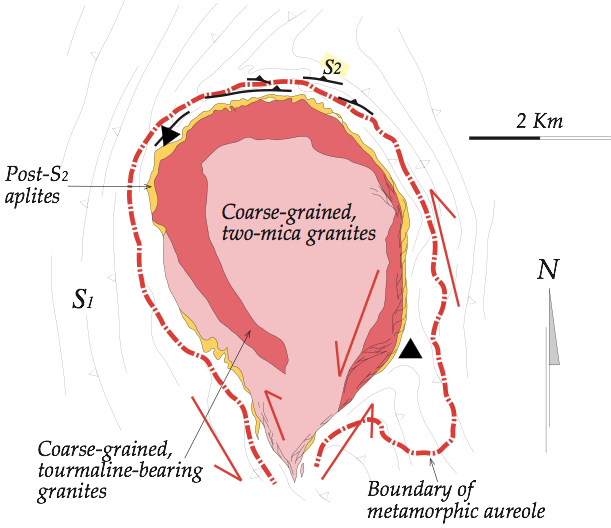
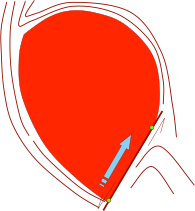
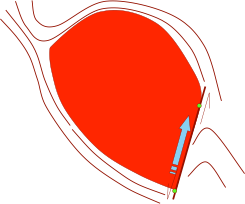
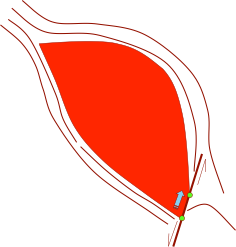



The inerpretation: Opening and rotation of a tension gash in which the granite magma is being progressively accommodated to form an apparently-concordant pluton
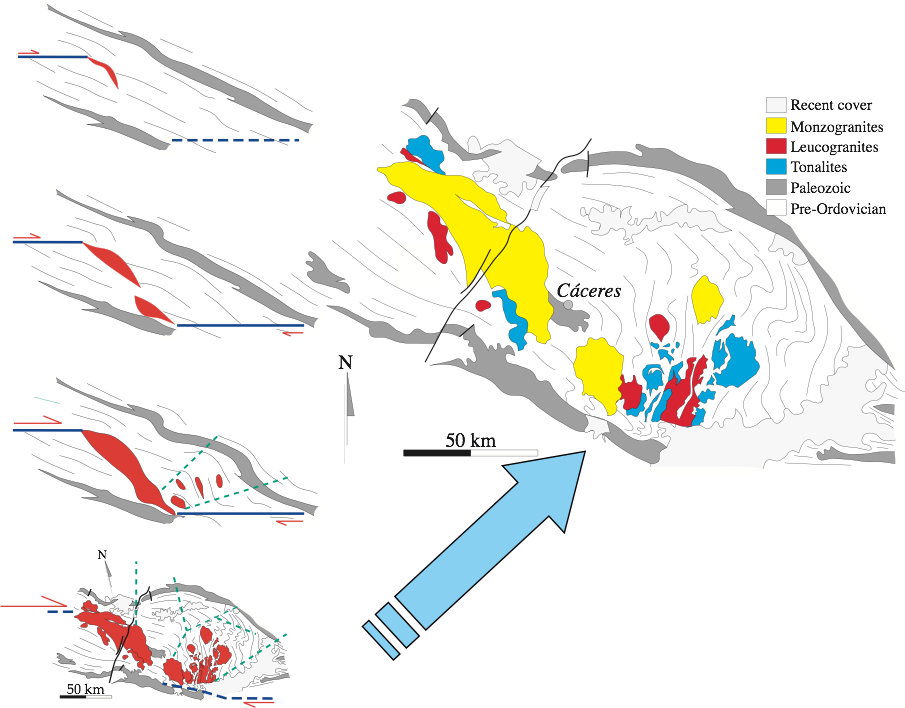
The inerpretation: Opening and rotation of a tension gash in which the granite magma is being progressively accommodated to form an apparently-concordant pluton
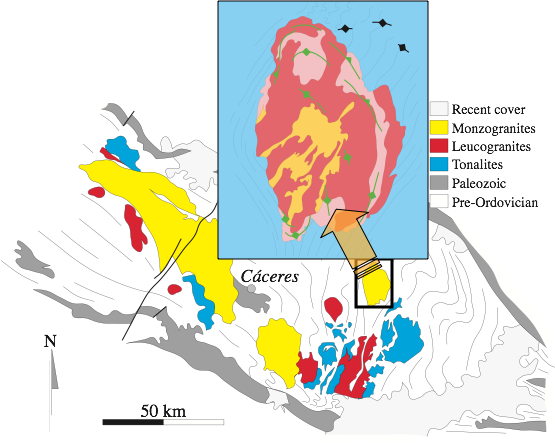
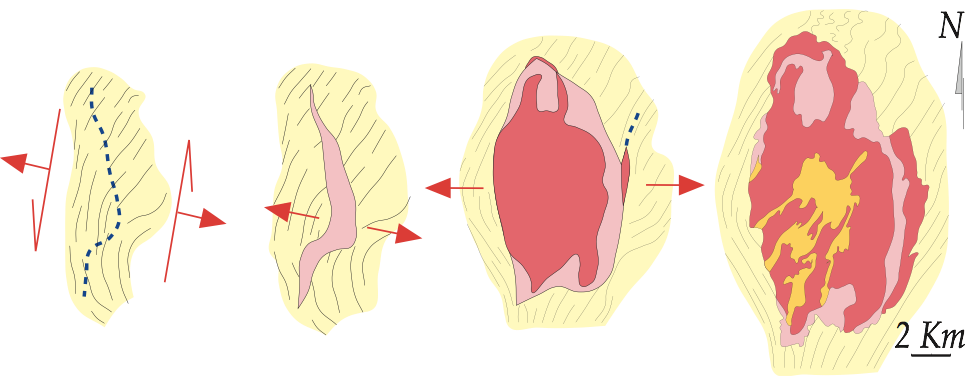
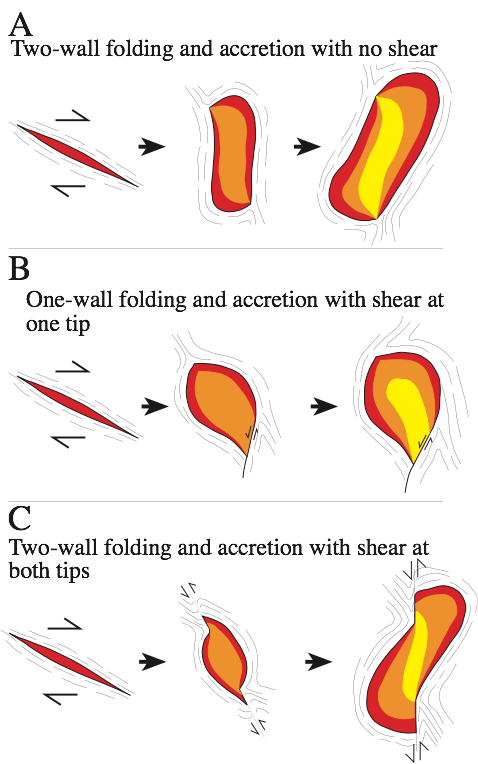

The Trujillo pluton is another example of pluton emplacement by accommodation into an opening fracture. Below is the interpretation proposed by Carlos Fernández.
The Cabeza de Araya pluton is another example of complex emplacement by propagation of two extensional fractures in a tension bridge.
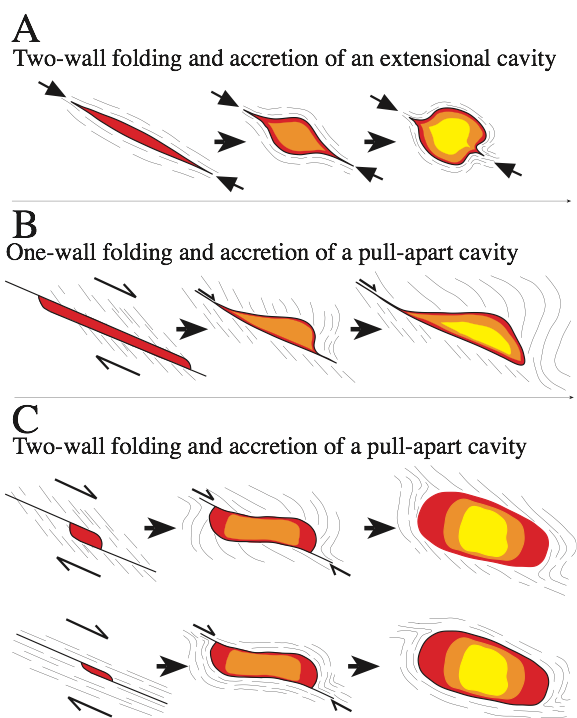
And here we propose (Fernandez and Castro, 1999; Castro and Fernández, 1998) a general model for empalcement of the Central Extremadura batholiths. This ia based on the early interpretations given by Castro (1986)
Castro, A. 1986. Structural pattern and ascent model in the Central Extremadura batholith, Hercynian belt, Spain. J. Struct. Geol. 8, 633-645.
Castro, A. ; Fernández, C. 1998. Granite intrusion by externally induced growth and deformation of the magma reservoir, the example of the Plasenzuela pluton, Spain. Journal of Structural Geology 20, 1219-1228.
Fernández, C.; Castro, A. 1999. Influence of crustal anisotropy and strain rate on pluton emplacement in strike-slip releasing structures: the Central Extremadura batholith, Spain. Journal of Structural Geology 21, 1143-1149.