
Coordinated project
NURISOL: Nuclear reactions and instrumentation studies for the ISRS spectrometer PID2024-159209NB-C21-C22
Participants:
- University of Huelva (Spain)
- University of Valencia (Spain)
Summary:
The present proposal continues with the R&D activity developed by the research groups of the University of Huelva (UHU) and University of Valencia (UV) in the previous projects ELEGANT2-PID2021-127711NB-I00 and the Subproject ISOLDE ISRS experiment of the Agreement between CIEMAT and Spanish institutions to support experiments at CERN (BOE-A-2023-16885), both funded by the Spanish Government. The new proposal Nuclear Research and Instrumentations for ISOLDE NURISOL carries on with experiments of nuclear reactions induced by exotic and stable nuclei at national and international facilities, nuclear instrumentation, and beam dynamics studies in the framework the Letter of Intent ISOLDE Superconducting Recoil Separator ISRS CERN LOI-INTC-I-228 (2021). The research in exotic nuclei and related instrumentation is prioritized by the Nuclear Physics European Collaboration Committee (NuPECC) in its latest report NuPECC Long Range Plan 2024, where the R&D on ISRS is endorsed. NURISOL also takes advantage of CERN LS3 period 2026-2028 for contributing to the installation and test in ISOLDE of two important ISRS prototypes, the Ion Test Bench (IONTB) and the Multi Harmonic Buncher (MHB) that will be used in the experimental program of HIE-ISOLDE after LS3. The goals of this ambitious research program can only be achieved in the framework of a Coordinated project, by merging interdisciplinary expertise on nuclear physics, nuclear instrumentation, and beam dynamics. NURISOL foresees the use of Spanish accelerator facilities, university laboratories, training of students, and collaboration with national and EU industry. The Coordinated project is composed of two sub-projects, NURSING-ISRS (Univ. Huelva) and BED-IN-ISRS (Univ. Valencia).
Subproject 1: Nuclear reactions and instrumentation for the ISRS spectrometer (NURSING-ISRS).
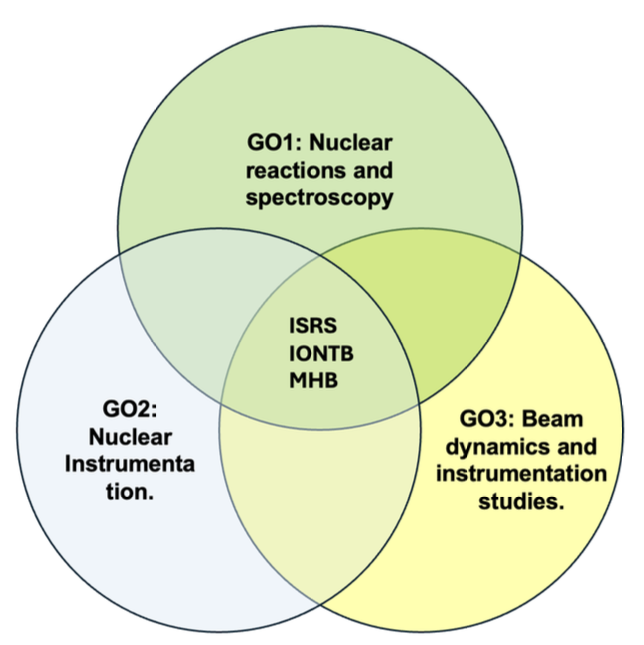
The NURSING-ISRS subproject is a follow-up to the previous project ELEGANT2 PID2021-127711NB-I00 (2022-25) funded by the Spanish Government. It continues with the long-standing R&D program of the UHU team on nuclear reactions with stable and exotic nuclei, nuclear electronics, and the contribution to the development of the ISRS spectrometer at CERN ISOLDE (CERN LOI INTC 228/2021). The team at Huelva University is composed of nuclear physicists and electronic engineers. It has a long tradition of interdisciplinary research in nuclear reactions with exotic and stable nuclei and nuclear instrumentation. The subproject is structured in two complementary lines of research “Nuclear reactions and spectroscopy” and “Nuclear instrumentation”. The first one focuses on the study of the structure and reaction dynamics of atomic nuclei, by carrying out reaction experiments with stable and radioactive beams at national and international accelerator facilities. In the same line tse also contribute to the installation and physics program of the Ion Test Bench (IONTB) at the ISOLDE facility at CERN. IONTB is a prototype of one of the beam-transport cells of ISRS, aiming to prove ISRS operation principles. The system can operate as a linear spectrometer and will be used for reaction experiments at HIE-ISOLDE after LS3. The second line of research focuses on the development of digital methods of pulse analysis for ion detection and identification at IONTB. The R&D program encompasses beam diagnostics studies and the new material SiC for ion (A,Z) identification at the focal plane detector. Dedicated SoCs will be produced of high-density spectroscopic channels. The research will combine designs with low voltage, consumption, noise and cost.
Subproject 2: Beam dynamics and instrumentation for the ISRS spectrometer (BED-IN-ISRS)
The present subproject, BED-IN-ISRS (Subproject 2 of this coordinated project proposal), will be part of the NURISOL Consortium, which comprises two partners: the University of Huelva (UHU) and the University of Valencia (UV). The project’s primary objective is to advance the R&D program for the development of the ISOLDE Superconducting Recoil Separator (ISRS), an innovative high-resolution spectrometer for the HIE-ISOLDE facility at CERN. The ISRS is based on a highly compact superconducting ion storage ring, incorporating novel short superconducting multifunction magnets that combine quadrupolar and dipolar functions. Operating in isochronous mode, the ISRS will function as a high-resolution mass spectrometer with the potential to expand the nuclear physics program at ISOLDE, enabling the study of more exotic isotopes generated in the secondary target. The design, computational modeling, performance studies, and prototyping of key components, such as the superconducting multifunction magnet and the multi-harmonic buncher (MHB), are currently underway. The superconducting multifunction magnet proposed in this project features a novel wiring topology, and its precise testing with a real ion beam at ISOLDE is crucial for validating its performance. Additionally, the MHB is essential for adapting the time structure of the ion beam to align with the ISRS operational cycle. This work is being conducted under the subproject ISOLDE Experiment ISRS in agreement with CIEMAT (BOE-A-2023-16885), which is set to conclude in December 2025. To ensure the successful continuation of this R&D program beyond 2025, the leaders of the collaboration, UHU and UV, are requesting additional funding through this application. These funds will support the completion of the ISRS development program, including the design and installation of an Ion Test Bench (IONTB) at ISOLDE to evaluate the prototype components developed for the ISRS. Notably, the ISRS R&D program delivers outcomes that go far beyond mere technology demonstrators. The IONTB itself can function as a linear spectrometer for nuclear physics experiments, while the MHB can be integrated into the HIE-ISOLDE facility to lower the LINAC frequency. Within this context, the BED-IN-ISRS subproject, led by Dr. Javier Resta López at UV, will develop the following key research activities: (1) Beam dynamics and performance studies of both the ISRS and IONTB; (2) Installation and commissioning of the IONTB; and (3) Installation and commissioning of the MHB. This R&D program will be carried out by the teams at UV and UHU, working in close collaboration with experts from external research institutions and universities. The collaboration with CERN is well established through the Memorandum of Understanding CERN-MoU-2026-015-ISOLDE. A team led by Dr. Ibon Bustinduy from ESS-Bilbao has fabricated an MHB prototype and will collaborate on the installation tasks at CERN ISOLDE. Additionally, the QUASAR group from the University of Liverpool, led by Prof. Carsten Peter Welsch, who is also a member of the work team for this proposal, will contribute to the installation and commissioning of the MHB, as well as the development of additional beam diagnostic devices for comprehensive ion beam characterisation.
Key words:
Reactions, nuclear, CERN, electronics, superconductor, beam, optics, diagnostics, accelerators
Impact. NURISOL
NURISOL addresses the knowledge of the atomic nucleus from an interdisciplinary perspective, by combining basic nuclear research in reactions with exotic nuclei, the construction of superconducting spectrometers, and the development of digital electronics for nuclear spectroscopy. The large impact expected in exotic nuclei research and associated instrumentation is summarized by the Nuclear Physics European Collaboration Committee (NuPECC) in its latest Long-Range Plan 2024. The goal of nuclear physics is to understand the nature of the strong interaction by conducting experiments at facilities in Europe and abroad, where the team is playing a leading role. The proposed experimental nuclear physics program is expected to unveil new reaction mechanisms and structures at the limits of stability, where the extreme N/Z ratios produce exotic clustering, neutron skin, halos, or the migration of magic numbers. The NURISOL team has recently contributed to these discoveries with the confirmation of proton and neutron haloes in 17Ne and 15C using Coulomb barrier reactions. A very innovative aspect of NURISOL is the construction and operation of IONTB, the prototype of a superconducting beam-transport cell, of the Isolde Superconducting Recoil Separator ISRS being developed for the ISOLDE facility at CERN (LOIN-INTC-228, Spokesperson: I. Martel). IONTB will be installed at ISOLDE to probe the beam dynamics and operation principles of ISRS. It integrates the MAGDEM magnet, the first ever prototype, an iron-free multifunction (nested dipole & quadrupole) Canted-Cosine-Theta superconducting magnet. MAGDEM is cooled down to operational temperature with a single cryocooler, thus no Liquid Helium supply is required. IONTB will set the path for a new class of particle spectrometers and particle storage rings. Large impact is expected in the construction of a new generation of gantries and accelerator systems for radioactive isotope production, tumour treatment, energy production and nuclear waste. IONTB will operate also as a very compact CCT-linear spectrometer, the first ever system of this class. The ISRS R&D program has been endorsed in the NuPECC Long Range Plan 2024. In the present project digital methods of pulse analysis will be developed for ion detection and identification for IONTB using SiC sensors, including low-noise and high-speed front-end systems. Dedicated ASICs will be produced of high-density spectroscopic channels, in CMOS technologies. The research will combine designs with low voltage, consumption, noise and cost. These developments can be used to other disciplines for the design of new, simpler and cost-effective detector systems, where a single stage can be used for particle identification. Each of the developments of this project presents a level of innovation that the possibility of generating patents is evident, as well as high-impact publications in technical and scientific journals. The Plan for Internationalization and Dissemination of the Results is based on publications in high impact journals and contributions to international conferences and workshops in the fields of basic nuclear physics, nuclear instrumentation, and nuclear electronics. In this project we will train physicists and engineers in nuclear instrumentation, work with national companies and develop transfer-of-knowledge to local an EU industry.
Interaction between workpackages/objectives


