Audiovisual narrative and image digitization as a phenomenon of tourist attraction in the city of Madrid. Money Heist as a generator of tourism emotionally and culturally linked to the urban spaces depicted in the series
La narrativa audiovisual y la digitalización de la imagen como fenómeno de atracción turística en la ciudad de Madrid. La Casa de Papel generadora de un turismo vinculado emocional y culturalmente a los espacios urbanos representados en la serie
María Pilar Yébenes Cortés
Universidad Europea (España)
José Jesús Vargas Delgado
Universidad Europea (España)
VOL. 6 (2025)
ISSN 2952-2013
https://doi.org/10.33776/EUHU/linguodidactica.v6.7684
Abstract:
Discovering cities through the images of television series has come about, among other factors, because of the use of urban spaces and their buildings as essential support elements in fictional narrative. Places and settings that are more or less well-known, emblematic, or anonymous scenes in which individuals are diluted in locations that are easily recognizable and assimilated in different latitudes. These images, many of which are digitized and are the result of post-production, mark the development and innovation of different audiovisual television formats and their impact on the society of “platform users”. They reach the spectator in the form of altered realities in locations and architectural structures that do not always correspond to the original, whether it be their real location or their real functions. This is what happens in Money Heist (Álex Pina, Netflix: 2017-2021) with the CSIC building, the Nuevos Ministerios building and other locations that are studied in this article. These are representations of elements which create the necessary interconnection and involvement between characters and viewers, and prompt the latter to go see where they are located. This is a visual artifice of cinema and television that enables the illusion of being in altered but somehow identifiable realities, which is why they are familiar and close, that is to say, credible. This is how screen tourism has been created, with tourists choosing their leisure destination based on the places they see in series on digital platforms. The paper’s findings indicate that the series Money Heist reconfigures the image of Madrid, imbuing it with a persona, and makes a significant contribution to the development of innovative experiential tourism. Moreover, the research work unearthed a predominantly favorable attitude amongst viewers towards prior exposure to television series such as Money Heist, which serves to attract visitors to Madrid through motivation and curiosity.
Keywords:
Audio-visual tourism; Audio-visual storytelling; Digitization; Money Heist; Tourism boom; tv series; Urban space
Resumen:
El acercamiento a las ciudades a través de la imagen televisiva en formato de serie televisiva se ha producido -entre otros factores- porque la ficción ha recurrido a los espacios urbanos y a sus edificaciones como elementos de apoyo esenciales en la narración. Lugares y escenarios en mayor o en menor medida conocidos, emblemáticos, cuando no anónimas escenografías en las que se diluyen los individuos en situaciones fácilmente reconocibles y asimilables en diferentes latitudes. Imágenes, muchas de ellas digitalizadas y fruto de la postproducción que marcan el desarrollo e innovación de la imagen televisiva en sus diversas ventanas audiovisuales y su impacto en la sociedad de los “usuarios de plataforma”. Las imágenes llegan al espectador en la forma de realidades trastocadas en emplazamientos y estructuras arquitectónicas que no siempre se corresponden con el original, ni en su ubicación ni en sus funciones reales. Es lo que ocurre en La casa de papel (Álex Pina, Netflix: 2017-2021) con el edificio del CSIC, el de Nuevos Ministerios y otras localizaciones que quedarán estudiadas. Representaciones de aquello que crea la necesaria interrelación y complicidad entre personajes y espectadores y que provocan que quieran conocer dónde se ubican. Un artificio visual del cine y de la televisión que permite la ilusión de estar en realidades suplantadas, pero, de alguna manera, identificables, de ahí que resulten familiares y cercanas, es decir, creíbles. Así es como se ha llegado a crear el turismo de pantalla que elige su destino de ocio por los lugares que ven en series de plataformas digitales. Los resultados revelaron que el relato visual transforma la imagen de Madrid, la personifica y contribuye al turismo experiencial innovador. Asimismo, se descubre una postura mayoritariamente favorable de los espectadores hacia la visión previa de series como La Casa de Papel, que atraen a Madrid mediante motivación y curiosidad.
Palabras claves:
Auge turístico; Casa de papel; Digitalización; Espacio urbano; Relato visual; Series de televisión; Turismo audiovisual
Fecha de recepción: 11 de abril de 2025
Fecha de aceptación: 27 de septiembre de 2025
Contacto: jjesus.vargas@universidadeuropea.es
And you know that Madrid
exceeds as with ardor
many great cities
in riches and desires...
I don’t know who the Big Ones were
I can only say
that no one in so great a place
can be called little...
(Al pasar el arroyo. Lope de Vega)
1. Introduction
Money Heist is a brand that is an ally of tourism agents. Netflix and the online consumption of audio-visual content encourage a type of screen tourism, which highlights tourist sights of Madrid as a high-profile destination. Digital art has produced a change in the city’s cultural dynamics, which has become essential for continued global development and progress. The representation of Madrid as a destination from an interdisciplinary perspective analyses in more detail the empathy and connection with the series’ intertextual narrative, and the relationship created with the characters. The symbols created by years of watching the series produce a multiple perception of one of the most visited cities in the world.
Madrid is one of the major filming locations in Europe, a main audio-visual production and distribution hub that has grown over the years. According to Borja (2003), the city’s urban center is essential for the mobility of persons, the organization of services and companies, social relations and symbolic perception. The diverse urban space and heritage of the city of Madrid, and of the Autonomous Community, comprise an important incentive for the national and international audio-visual industry. The production of series filmed in the city and in the region has increased due to tax incentives, the availability of a large number of filming locations, innovative animation and VFX studios, and a powerful infrastructure network. Moreover, Madrid has the capacity to house in one city people from different parts of Spain and the world, of benefitting from its transport network and from the economic reactivation of the territory. In other words, Madrid is the epicentre of audio-visual production thanks to the availability of these aids and support mechanisms.
The process of globalization is not new, and is inherent to the evolution of capitalism. At present, it is subject to accelerated change, both in quantity and quality, linked to the development of the productive forces with the advancement of neoliberal policies and their ideological messages, and in particular, technological progress in the transmission of information (Margulis, 1988, p. 7, as cited in Soto Fernández, 2023, p. 105).
Hence, we find ourselves in an optimal environment for the development of information and knowledge regarding the diversification of entertainment that provokes feelings and pleasures, which viewers seek and long for in the culture of television consumption and audio-visual pastimes.
Organizations specialized in tourism issues dependent on the Community of Madrid strive to increase the number of visitors to the region. Tourism, one of Spain’s main sources of income, is constantly growing with the diversification of the type of tourists, which makes this socioeconomic progress possible. The General Directorate for Tourism promotes and establishes strategies that encourage the promotion of different products to satisfy the tourism sector at the national and international level. The film industry and the expansion of the new television model are the triggers that have led to the increase in the number of viewers, who have become a new type of tourist; i. e. the audio-visual tourist. On the other hand, in the sphere of public audio-visual institutions, Film Madrid at the level of the autonomous Community and the Madrid City Office (Office of the Madrid City Council for filming) are the entities in charge of providing advisory services and processing the filming requests. Film Madrid, the Madrid Community office for the promotion of filming, which depends on the Ministry for Culture, Tourism and Sports of the Community of Madrid, is the entity that provides the tools to help the industry speed up the processes and in consequence increase the number of national and international filming. As highlighted by Rafael Cabrera, General Coordinator of Film Madrid, “in 2022 the Community of Madrid was the territory chosen by platforms and producers to shoot 71% of the series.” The Spain Film Commission (SFC) is the entity that groups together the autonomous Community, provincial and municipal Film Offices.
Screen tourism has established itself as an effective strategy for attracting tourists to destinations that appear in films and television series. Various international cases demonstrate that appearing on screen can significantly increase interest and tourist visits to a place.
Table 1
International cases and tourism impact
Destination / Case |
Featured Production |
Tourism Impact |
References |
Dubrovnik, Croatia |
Game of Thrones |
Strong and measurable increase in tourist arrivals, with positive regional and national effects |
|
Thailand |
Lost in Thailand |
Significant changes in volume and patterns of Chinese tourists after the release |
|
Isle of Mull, Scotland |
Balamory (children’s series) |
Attraction of visitors inspired by the show, with implications for destination management |
|
Seoul and Nami Island, South Korea |
Daejanggeum, Winter Sonata |
Rise in international visitors and tourism experiences focused on scene re-creation |
|
Hengdian World Studios, China |
Various Chinese productions |
Promotion of tourist loyalty and emotional connection to the destination |
(Zhou et al., 2023; Cui & Song, 2024) |
Seville, Spain |
Various international films |
Tourist motivations influenced by film experience and novelty |
|
United Kingdom |
Harry Potter, The Prisoner, etc. |
Multiple sites have seen increased visitors and development of fan-generated content |
Source: own elaboration
Other strategies and success factors include:
- Destination image and emotional attachment: The presence of celebrities and charismatic characters on screen improves the image of the destination and fosters attachment, which increases loyalty and the intention to visit (Yao & Yang, 2024; Zhou et al., 2023; Chen, 2023).
- Events and festivals: The organization of film festivals also attracts tourists, especially in countries with a strong artistic identity (Kendall et al., 2020).
- Technology and fan engagement: The use of apps, social media, and fan-generated content amplifies the appeal and promotion of destinations (Jones, 2025; Bengesser & Waade, 2021).
2. Methodology
In this paper this tourism phenomenon is studied using a multidisciplinary qualitative and inductive approach applied to some emblematic buildings in Madrid’s urban area. The objective is to identify how the series Money Heist (Alex Pina, 2017), used as a case study (Stake, 1995), has increased the number of tourists who travel to Madrid to discover on-site and first-hand the filming locations of their favourite series, and how new diverse emotional links are established with the city, taking into account a sample of adult viewers.
The qualitative instrumental case study methodology (Stake, 1995) explores qualitative data in depth.
- It analyses the contents of the series, locating the streets of Madrid on the basis of a review of the series, with 1 or 2 viewings by 1 or 2 experts.
- It finds tourist initiatives in connection with these streets by checking web documents in which both public and private initiatives appear.
- It finds the emotional perceptions of the viewers of the series from a sample of young adult viewers.
- It establishes the extent to which this tourist behaviour exists based on an audio-visual phenomenon which is scattered, difficult to account for and somewhat complex.
The scale of this type of tourism will be determined using three dimensions of analysis:
- A macro approach in order to understand the reference of the proposed audio-visual text, developing a theoretical and referential framework in the context of the definition of screen tourism based on the buildings and places of the city where the series was filmed.
- Anthropological and psychological-emotional analysis provided by answers related to the terminological tandem audio-visual production (fiction series) and city. There are two dimensions in the modern vision of landscape: a descriptive one (the scientific or explanatory aspect, of a more objective nature) and the sentimental aspect (the artistic or aesthetic side, the comprehensive facet, which is more subjective) (Ortega, 2006).
- Qualitative analysis of the perception of the series Money Heist as a phenomenon of tourist attraction to Madrid for part of a group of 10 young adult viewers, with the qualitative technique of group discussion.
Hence, the objectives of the research process entail:
- highlighting the screen tourism phenomenon that resulted from the series Money Heist in connection with initiatives of public and private institutions, which contributed thereto;
- focusing on the growing relevance of the architectural uniqueness of public entity and financial institution headquarters shown on television as tourist attractions in Madrid; and
- discovering the emotional perceptions and interpretations of viewers of the series Money Heist that determine the need to transfer and extend their subjective screen experience by means of the direct contact with the real locations where the series was filmed.
3. Results
The first part of the results is presented below, bearing in mind the analysis of the series and the architectural singularity of the headquarters based on the macro, anthropological and psycho-emotional perspective of the series, from which three categories are obtained. The three categories are synthesized in Figure 1, and are described below.
Figure 1
Results from the series Money Heist regarding urban tourism in Madrid
Source: own elaboration
3.1. Money Heist as a transformative element of urban tourism in Madrid
At present, audiovisual stories constitute a considerable part of our world experience and form a fictional universe that attracts the interest of professionals and entails a channel for the transfer of knowledge. The tourist image of a destination is based on the perceptions of the reality a traveller experiences or notices in that destination (Gartner, 1993; Puche-Ruiz & Gámir, 2023). In the summer of 2022 Netflix prepared, in collaboration with Sandema, free guided tours around Madrid to visit the locations of the contemporary fictional series Money Heist (Álex Pina, Netflix, Vancouver Media, 2017). The platform, which had launched with Turespaña the Spain Travel Guide project, became a new channel through which to increase tourism with the expansion and development of audiovisual productions. In addition, the start-up GuruWalk, part of the international free tour community that connects travellers with guides around the world, offers guided visits to the buildings and locations where the series was filmed.
Both tourism and the audiovisual sector, in particular fictional series, entail dynamism, sensations and movement as an individual experience on one hand, and as a symbol of progress and modernity on the other (Hellín y Martínez, 2009). Nonetheless, the tourism figures for Madrid in 2022 must be taken into account. Between the months of June and September 2022, the large, more international cities of inland Spain had the lowest rate of recovery of income from tourism, measured on the basis of hotel RevPAR with respect to 2019, due to the absence of tourists from Asia. Despite this situation, these cities were able to move closer to the 2019 levels thanks to a noteworthy improvement of prices in conjunction with the noteworthy improvement of their products, as in the case of Madrid (RevPAR: +0.2 %, ADR: +14.3 %, occupation: -12.3 %) (Exceltur, 2022).
The series’ audiovisual narrative language is complex, and very attractive for the senses. This is due to the nature of this type of language, which combines multiple codes, amongst which image, sound, written text, dialogue and performance stand out (Villafañe, 2001). This language is what enables establishing a bond between the spectator and the tourist sights. A study carried out in 2021 by Qutub et al identifies the characters of the series who inspire the most empathy amongst viewers.
Money Heist (Álex Pina, Netflix: 2017-2021), the television series subject matter of this multidisciplinary study, has dynamized and positioned a considerable number of Spanish fiction series. Moreover, with the Netflix platform, the series has boosted dissemination of Spanish productions and the professionals involved. By means of the images filmed in Madrid with the city’s characteristic buildings, in addition to the narration of the story itself and construction of the characters, the series has appealed to tourist-viewers all over the world.
This is the so-called series- or screen- tourism, in which tourists choose their holiday destination based on the series they watch. The profiles of this new trend, which for the time being is not fleeting, comprise a target population of young people between the ages of 16 to 38, closely linked to social networks and contextualized in tourism that is timeless. The series consists of five seasons, filmed from 2017 to 2021, with four years of filming and two robberies in the main plot. The action takes place under the umbrella of these buildings, the sites that the series viewers wish to visit. However, screen tourism is also considered a problem for quantitative analysis due to the lack of statistics, which are not yet provided by the Secretary of State for Tourism.
The series Money Heist, most of which was filmed in the city of Madrid, first appeared in 2017 on the free-to-air television chain Antena 3 TV. The first season audience totaled 4,500,000 viewers, decreasing by 50% the second season. The series was later purchased by Netflix, which acquired the seasons that had already been broadcast in Spain and included them in the platform’s international catalogue. Shortly afterwards, the series ranked second in The Most Popular TV Shows according to IMDb Users, with a rating of 8.6, below Stranger Things (2016) and above The Boys (2019).
Like with films, the shooting locations of the series constitute a specific form of expression, and not merely a description of the surroundings where the action takes place. In turn, this leads to the motivations for choosing specific settings in Spain’s capital city, and through these sites to the development of a bond between the series and the viewers. This connection transcends simple entertainment, giving rise to global audiovisual viewers who become involved and want to learn everything they can about their process of connection with the characters of the series’ plot.
Some of the buildings chosen for the filming of Money Heist (Netflix, Vancouver Media, 2017) underwent a modification of their architectural reality, as a technical and narrative production requirement. Due to security issues and filming difficulties arising from heavy traffic, in the first season of the series the National Mint and Stamp Factory (La Fábrica Nacional de La Moneda y Timbre - Jorge Juan Street 206) was substituted with the Spanish National Research Council (Consejo Superior de Investigaciones Científicas - CSIC) on Serrano Street 117 in Madrid.
In the plot, the building in which the robbery occurs supplants the functions of another building. The rooftop terrace of the National Mint and Stamp Factory is in fact the rooftop of the Superior Aeronautical Engineering School of the Polytechnic University of Madrid at Plaza Cardenal Cisneros. Its stylistically classicist architecture, austere monumentality and huge dimensions create the illusion of a symbol of power which responds well to the challenge expressed by the Professor: “There are no great battles without great adversaries.” That is the keystone that justifies using a building with sufficiently solid proportions to give credibility to an assault on the core of a country’s financial system.
The regal Bank of Spain is also supplanted in the series. This building is one of the icons expressed Money Heist’s narrative as the focal point and the thieves’ objective in the series’ third and fourth seasons.
The Bank of Spain is replaced by the headquarters of the Ministry of Development, renamed in 2020 as the Ministry for Transport, Mobility and Urban Agenda, located at Paseo de la Castellana 67. This government complex was built between 1933 and 1942. The interest of this building is highlighted in the following text:
... some of the persons who walk hurriedly through the Plaza de la Cibeles may look with covetous eyes at the large and impressive building of the Bank of Spain on the south-west corner of the square. For it is here, beneath this massive bulk, that the 90 tons of gold bullion that constitute part of Spain’s reserves are safely stored, along with an extraordinary collection of coins, the precious treasure that prevents the cash circulating around the country from being nothing more than worthless scraps of paper. Each of these gold bars, weighing 12.5 kilos, is worth approximately 200,000 euros, making the gold reserves stored their worth about 1.5 billion euros (Besas, 2010).
To illustrate this point, the following link is provided in order to view Image 1: a frame of the Nuevos Ministerios building from the series Money Heist, simulating the Bank of Spain. Source: La Vanguardia (lavanguardia.com) https://www.lavanguardia.com/series/20211223/7948468/casa-papel-engano-pmv.html
Tourist visits to the Bank of Spain were suspended in March 2020 when the lockdown was ordered in Spain, and did not resume until May 2020. In consequence, the entity only has data and statistics for visits between January and March 2020. During that period, the Bank received a total of 4,938 visitors from its different programs of visits. Of these, 1,281 visited the central headquarters in Madrid and the rest visited the other branches (Bank of Spain Divisions for Media and Reputation).
To illustrate the point made, Image 2 can be accessed via the following link: a frame of the CSIC in the series Money Heist, which replaces the National Mint and Stamp Factory. Source: lugaresdepelícula.com http://www.lugaresdepelicula.com/la-casa-papel-se-rueda-csic/
3.2. Money Heist as part of the story of a place of power: transmutation of Madrid as the plot’s fundamental character in a narrative space that interacts with viewers.
The influence of buildings and filming locations in the perception of television viewers who recognize the surroundings, the street, the urban landscape and its history convert Madrid in a cult tourism setting based on an expressive narration that suggests different points of view. This way, the city of Madrid is personified. The Paseo de Recoletos and Paseo de la Castellana, as well as the city’s centre, have mutated in the last quarter of the century from a setting consisting of palaces and houses only several stories high and industrial shops, where a hardworking population lived, into a setting in which it is difficult to depict the urban planning, architectural and social vision it represents at present (Azorín y Gea, 1990).
In the century-old wake of cinematographic art as an educational and tourism resource with a distinctive narrative and visual language, we have been able to approach popular territories that have taken us to the most remote cities, both physically and in terms of form and content, resulting in the development of critical audio-visual thinking. The series Money Heist has created an emotional bond with particularly interested viewers, causing in Madrid a great flow of tourists in search of its filming locations.
This is the premise with which tourists link certain beliefs, tastes and emotions caused by watching the series with the desire to visit the associated sites, and from which the stimuli that constantly incite and nurture their need arise.
Globalization of television as a communication medium in connection with the globalization of cities helps understand how the flows of persons and tourists whose experience of the city they visit is often defined by the manner in which the city of Madrid has become the setting of the images seen in the series. This is a movement of persons who determine a type of tourism that stems from the media message produced by audio-visual images as a result of postmodern culture: a new model of culture, which James Clifford (1992) explains as follows: “The challenge of representation is seen as the description and understanding of local/global encounters, it is necessary to focus on both hybrid and cosmopolitan experiences as well as native and rooted experiences...”. Not only are we submerged in a new state of tourism, but also face new concepts of culture for the study of television: a new manner of expressing the essentialist concept of identity which we can analyse with different models of representation in which we assume that there is a real identity and that every person in the nation partakes of the collective identity.
The city of Madrid and the buildings where the plots of Money Heist take place, in other words the real spaces converted into fictional ones to satisfy the needs of the stories that are filmed, and which from the perspective of transmedia narrative want to be a part of the series. become the lure for screen tourism. This is the most effective marketing tool for audio-visual productions. The promotion that stems from television series, both in Spain and abroad, is the essence of the cultural policy that has been successfully promoted by the Spanish audio-visual industry. The filming locations of series, as well as films, constitute a specific form of expression, and not just a description of the surroundings in which the former take place. This in turn leads us to consider the motives for choosing the specific locations.
To illustrate the point made, Image 3 can be accessed via the following link: a frame of the rain of bills of the series Money Heist. Source: areajugones.sport.es https://areajugones.sport.es/wp-content/uploads/2019/01/la-casa-de-papel-0028.jpg
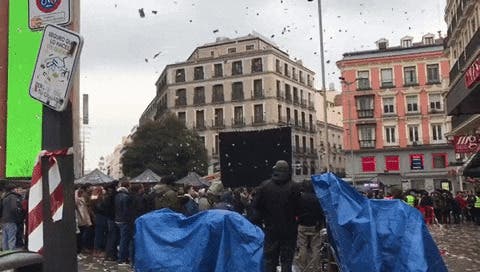
Hence, the idea of a monolithic Madrid does not exist, but appears outlined in greater detail with the enclaves of the filming locations of Money Heist. One of those locations is Plaza del Callao in Madrid’s central Sol district, where one of the sequences of the first episode of the series’ third season took place in 2017. This space, an important and busy artery of Madrid, which is not easily identifiable outside Spain, like London’s Picadilly Circus is. Until the decade of the 1970’s, most cinematographic cities seemed more like models of a city than real places (Sorlin, 2016, 21).
The sequence of the rain of 140 million euros in 50 euro bills at Plaza de Callao demonstrated and staged aspects of this crucial Madrid square that gives it absolute visibility from the entrance to the Callao metro station. This location is a meeting point for the inhabitants of the city, and becomes a tourist destination as if it were a building of special architectural interest or one of the city’s emblematic squares. Jesus Colmenar, who directed the sequence, and Cristina López Ferraz, director of production, together with the rest of the team, had to confront not only a specific physical place but also resolve how to narrate with images and sounds an event which had to situate all the other season’s episodes in the city of Madrid, and at the same time try to film the pedestrians’ thoughts, emotions and gestures. The staging and audiovisual language of this sequence is the bridge that links information and communication, on one hand – “We’re back” – says the voice-off of the character from Tokyo, and on the other, almost without having planned or knowing it, as an element of power for viewers who make decisions –to go to that place- during the short period of time it lasts.
3.3. Digitization of images, emotional intelligence and cinematographic art therapy as strategic resources of experiential connection in Money Heist
The tourist image of a destination is based on the perceptions or the emotional, intrapersonal and interpersonal constructions of its reality as experienced or perceived by the tourist. Persuasive tourism strategies can be applied by means of emotional intelligence and experiential connections of cinematographic art therapy to generate a subtle thread of emotional experiential bond with viewers, as made manifest in an evident special interest, provoking a large flow of tourists in Madrid in search of its filming locations.
One of the main primary objectives of cinematographic art is the function of informing and interpreting reality. Projecting rational informative communication from a basic linear standpoint is the primary aim. The secondary interpretative objective lies in the second derivative of rational cinematographic communication: a realm that explains and delves into reality, which it interprets and with which it apprehends. The third natural derivative is the emotional communication that can occur by means of art therapy strategies that generate a connection of emotional experiential bonding with the viewer (Vargas, 2019).
In 1990 Salovey and Mayer published a text that has become a benchmark for the contemporary concept of Emotional Intelligence (IE) and that has been applied to numerous research studies and dimensions. The IE concept reached its peak of popularity between 1994 and 1997, of which its principal exponent was the book Emotional Intelligence, Daniel Coleman’s celebrated work published in 1995 (cited in Vargas, 2019). When emotional intelligence is connected with theatrical or cinematographic art, a very sophisticated concept and tourism resource unfolds that generates images converted by a continuous marketing impulse into inseparable visual icons that remain in the viewer’s collective imagery, and that constitute the memory of national fiction.
López-Fernández-Cao and Martínez-Díez (2006), directors of the Master’s Degree of Art Therapy of the School of Education of the Complutense University, state that there is a definition of art that can show us elements related to art therapy; that is, a definition whereby art generates visibility and knowledge through the emotion of theatre and film. Theatrical and cinematographic art as therapy seeks to delve into the inner knowledge of human beings through aesthetic emotions and their expression (Vargas, 2019). In this combination of art and psychotherapy as an educational and tourist resource in which the most important element is the person and his/her process, art is used as a form of non-verbal communication and as a conscious and unconscious means of expression (Martínez-Díez y López-Fernández-Cao, 2004).
The dominant conceptions regarding staging expressions are not a mere description of the environment in which they are produced. They are based on a misunderstanding of the important functions they play in human development (Eisner, 1992). Eisner demonstrated that, by means of art therapy strategies, viewers are subjected, from an intellectual point of view, to few demands, which are more emotional than reflexive, having little to do with the mind, and that many of the more complex and subtle forms of thought occur when viewers have the opportunity of working in a significant manner in the creation of images, whether visual, recognized, choreographic, musical, literary or poetic, or the opportunity of being able to appreciate and incorporate them. The staging and audio-visual language resources used in Money Heist are the bridge that has served as a link for information and communication for the fiction, on one hand, and that becomes, on the other, an element of power and inspiration for viewers who apprehend and make decisions by turning to the filming locations as an emotional incorporation.
Money Heist succeeded in being an enticement in different countries in which viewers reuse fiction and convert it into a real setting of their own life experiences. The series’ original music, Bella Ciao, as well as the iconic masks inspired by Dali, constitute a social phenomenon used in demonstrations and street protests in favour of civil rights, and in defence of other democratic causes in countries of our European context and in the United States.
The capacity to create a form of experience that can be considered aesthetic requires a mind that incites our imagination and stimulates our ability to live experiences saturated with emotions (Eisner, 1992). Cinematographic art is a type of human experience, which, in principle, is always possible as long as a person interacts with some aspect of the world. One of the cognitive function of the arts is to help us learn how to observe the world. The filming locations of series and movies allow us to apply the imagination as a means to explore new possibilities. The arts are mediums to explore our own visible interior landscape. They also tell us something about the sensation that is generated by places and relationships (Eisner, 1992). They qualify us to place ourselves in the shoes of other persons, in this magic place, and to indirectly experience that which we have not experienced directly. The city embraces the series Money Heist, which embodies with the television fable the most emblematic buildings of Madrid, exhibiting their architectural effectiveness. Money Heist allows this experiential exercise of emotional bonding through reality, which provides an added interest that rational tourism communication is not able to achieve.
As a result of continuous marketing promotion, images produced in Money Heist are converted into visual icons that have remained in viewers’ collective imagery and constitute the memory of national fiction. Likewise, the role of image digitization in Jean Baudrillard’s idea regarding total simulation as an aesthetic and artistic analysis has shaped the arrival of television simulation in the face of reality in a state of seduction of the image itself.
The viewer of the series assumes the fiction within the fiction, without the need to resort to the construction of a dimension of the delusional, fantastic, in short, unreal concept of the image that irrupts in their view.
The force of the paradigm acquired and practiced in other series and films has enabled constructing a -truly false- criterion of reality. Digital technology has made possible the idea of the verb “assume”, the fictional trickery of the image, because it is part of the technological audio-visual scheme: the image as spectacle.
George Gerbner (1998) put forth interesting principles on the effects of the media, in particular television, on viewers’ cultural makeup. This is not just a matter of changes in certain behavior, such as copying the image of a celebrity or buying a product: “The cultivation concerns the implications of stable, repetitive, pervasive, and virtually inescapable patterns of images and ideologies that television provides (especially in dramatic and fictional entertainment)”. (Morgan and Shanahan, 1999, p.5). The quote refers to Gerbner’s studies regarding the Theory of Cultivation, one of the most complete contributions on the effects of television in shaping perceptions of reality (López y Gavilán, 2015:24).
The application of learning and connections by means of film art therapy generates a number of didactic effects expressed through a binding emotion that results directly in the full understanding and internalization of Madrid, provoking a large flow of tourists in the city in search of emotional recreation in its iconic filming locations.
3.4. Qualitative results based on a discussion group
A discussion group was formed with an exploratory approach. The results obtained from the group, consisting of 10 adult students enrolled in a Spanish University Master’s degree during the 2023-2024 academic year provided the following information: 6 members of the sample were female (60%) and 4 were male (40%), with a predominance of the female gender.
First of all, a preliminary quantitative question was asked: Do you believe that tourists visit Madrid because they previously watched television series such as Money Heist? The answers were the following: 7 persons (70%) answered “yes”, 2 persons (20%) answered “no” and 1 person (10%) answered “I don’t know”. Thus, the affirmative answer predominated.
Secondly, a qualitative question was asked: Why do you believe that series such as Money Heist can or cannot attract tourists to Madrid to visit the sites represented audio visually?
The results revealed 4 categories (motivation, cultural creations, curiosity and affective memory) and 4 codes (lifestyle, visit architecture, confirm physical reality and reminisce on happiness) that reflect an affirmative position. There were two negative categories (variability of the tourism offer and lack of relevance). Lastly, there was one confusing position. The results are shown in the following table 2.
Table 2
Qualitative Results
Position |
Categories |
Codes |
Descriptors |
In favour |
Provokes tourist motivation |
To see lifestyle |
The series also describes the lifestyle |
To visit architecture |
There is an incentive to go. |
||
The series creates culture |
Creates architectural culture, such as the itineraries |
||
Provokes curiosity |
To confirm the physical reality |
They come to see the physical reality. |
|
They come due to affective memory |
To reminisce on happiness |
||
Against |
Competes with a large variety of tourism proposals |
There are more tourist options. |
|
It is not relevant. |
For me it is not relevant. That is not a sufficient motive. |
||
Confusing |
I have opposing arguments, more negative than positive ones |
Source: Own elaboration
4. Discussion and Conclusions
The first contribution of this multimethod study is to show that the television series Money Heist is capable of transforming the image of the city of Madrid, attracting viewer-tourists, accordingly to Shi (2005) and Vila et al. (2021), and of embodying the city (Yang, 2020) so that viewers can interact with it, contributing to innovative experiential tourism Secondly, an exploratory qualitative analysis carried out by means of a discussion group supports these premises, taking into account that this is a minor conclusion. Given the large number of variables exposed, the discussion group provides grounds for a prospective study.
Additionally, the results of this study are consistent with other studies suggesting that television series, such as, for example, Game of Thrones (Depken et al., 2020; Parramon y Medina, 2017), can significantly increase urban tourism by promoting specific destinations (Conell, 2005; Wen et al., 2018), motivating visits based on the image and narrative of the sites filmed (Vila & De Carlos, 2021), and generating economic and social benefits for local communities.
Likewise, the study’s findings are aligned with a study by Barrado-Timón et al. (2022), in which the authors suggest that fictional series can transform the image of a city like Madrid, attracting experiential tourism and establishing relationships between narrative and geographic spaces through social media. Similarly, research carried out by Martínez-Sala et al. (2019) examined the role of social media in the promotion of film tourism, highlighting how television series can generate online communities that foster interest in visiting filming locations and experiencing the series’ narrative in person. Moreover, a study carried out by Domínguez-Azcue et al. (2021) analyzed the impact of Netflix series on tourism to Spanish destinations, finding a positive correlation between exposure to these productions and the interest of tourists in the filming locations.
Screen tourism has proven to be a powerful tool for attracting tourists internationally, with successful cases in Europe and Asia. The impact is greater when combined with marketing strategies, events, and active fan participation, generating sustainable economic and cultural benefits for destinations.
The city of Madrid, as well as many towns of the region, have been the setting of many film locations (Aertsen et al., 2022), whose numbers provide evidence of an exponential growth. The city’s urban landscape, with its streets and best known buildings as necessary elements of popular series such as Money Heist, has contributed to the increase in the number of visitors who come to participate in what is known as screen tourism. The impact of digital images has modified the credibility of the portrait in a series like Money Heist, where the discourse analysis mainly questions the democratic system whose characters endorse individualistic anarchism. Furthermore, digital images have stimulated the embellishment of the images that are viewed. In addition to the evident economic impact that this trend has on knowledge of the region, the direct benefits for the audio-visual industry itself and the growth of the tourism sector, triggered by the expansion of the television industry, must also be taken into account. However, one of the problems that this type of tourism faces is the lack of statistics.
In addition, there is no information regarding the number of tourists who come to the city or the region of Madrid every year after having seen a building, a park, one of the main streets that cross the urban center, or any other element of the landscape that appears in their favourite series or film. This reveals the lack of a clear strategy, defined and established in conjunction with public institutions, i.e. the Secretary of State for Tourism. Millions of viewers have watched the series Money Heist, initially when it was broadcast by Antena 3 television and then on the Netflix platform (Edgerton, 2022).
The projection given to the city of Madrid by the series at many moments of its running time explains the power it had to provoke perceptions and emotions leading viewers to have a direct contact with what they had seen on their television screen. The city is visited, discovered and enjoyed in spite of the risk of ending up transferring the fiction to reality. Many of these visitors expect to see, in the places and buildings where the series was filmed, what corresponds to the sphere of fiction as imagined by the script writers. In that case, the risk is distorting something that the inhabitants of the city see and understand in a completely different manner. On the other hand, the universal scope of everything that is seen on television and movie screens is an advantage that has an incomparable promotional effect. This way, series and films operate in favor of an experience in which the city is a tourist destination that alters all of the parameters with which we are used to travelling.
The cognitive organization of perceptions has been formed to favour the characters that represent a strong and attractive emotional bond who for viewers. The image that has become a banner for Money Heist by means of different empathetic filters, by using comic and ironic narrative elements and incorporating symbols full of significance, together with Bella Ciao as the hymn of popular resistance. It has turned into an element of infinite power that impacts on viewers’ emotions through the power of simulation, where references to reality are blurred.
The study of learning and effects through cinematographic art therapy produces numerous pedagogical effects expressed by way of a binding emotion that projects directly onto the full sense and interiorization of the city of Madrid, subtly provoking a large flow of tourism in search of the emotional recreation in its mythical sites. Money Heist has succeeded in creating a very strong bond of empathy and connection with viewers, where the virtual self blends with the real self, and which, by establishing false representations of reality, has converted Madrid in the filmed city of series.
In accordance with this research study, television series can increase awareness of the destinations they represent (Vila et al, 2021), presenting them as attractive places to visit and cultivating loyal audiences. In addition, the motivation to visit these places is influenced by the emotional and narrative connection that viewers develop with places shown in the series, which inspires their desire to see them in person. Likewise, this study is in line with the one carried out by Barrado et al. (2022). These authors argue that fictional series impact recognition of a city and its elements by representing geographical spaces in the audio-visual narrative, motivating viewers to visit them in real life. Additionally, the connection between the narrative and geographic is strengthened with on-site activities, such as guided visits to the filming locations, thus increasing the city’s appeal for tourists. Moreover, according to several authors (Barrado et al., 2022; Pereira-Villazón & Portilla, 2020), social networks are key in the promotion of destinations, since users share their experiences, influencing others to visit these cities.
Practical Applications
This study reveals the potential of transforming television series to promote tourism in cities like Madrid. The main practical conclusion focuses on the capacity of Money Heist to convert the audio-visual experience into an opportunity for experiential and innovative tourism. Tourist authorities and cultural agents can take advantage of this phenomenon to develop more dynamic and interactive marketing. The series enables personifying Madrid, creating an emotional connection between viewers and urban spaces that transcends traditional tourism. There is a clear opportunity to design specialized tourist products that integrate the series’ narrative with the city’s itineraries. The latter could include thematic tours, immersive experiences and events that recreate emblematic moments of Money Heist. Moreover, the research underlines the importance of encouraging the collaboration between the audio-visual industry and the tourism sector. Film and television products become territorial promotion tools with significant economic potential.
Limitations and Prospective
This paper’s limitation lies in that the study of innovative experiential tourism through television series is in its initial stages, with very little literature on the subject and a small qualitative sample of viewers.
In respect to prospective research, the phenomenon of television series and innovative experiential tourism is a field that is growing. Studies of other series should be analysed and compared with other destinations by means of a mixed or multiple combined methodology. In addition, the scope of the sample should be enlarged, both in respect to the number of viewers and the number of viewers who are also tourists. The study’s discussion group opens up a prospective field of research to delve into the multiple variables of film tourism. This entails the need to carry out more exhaustive studies that permit understanding and quantifying the real impact of these productions on the image and the economy of cities.
Notes
1 There is no information regarding the number of viewers of the first two seasons of Money Heist when they were broadcast on the platform, since at the time Netflix did not provide any data in that respect. The last three seasons on the platform rank amongst the top ten most watched non-English series. Part 5 of Money Heist ranks second, with 792,230,000 hours watched in the first 28 days, just below the first season of Squid Game (1,650,450,000 hours watched in the first 28 days). It is followed by Part 4 of the series in third position with 619,010,000 hours watched in the first 28 days, and in fifth position the third season of Money Heist with 426,400,000 hours watched in the first 28 days. In the broadcast of the first chapter in the month of May 2017, Antena 3 television had a share of 25.1%, with an audience of 4,090,000 viewers. The first fourteen chapters were broadcast, the last of which was on the 16th of November, 2017, with a share of 9.8% and 1,487,000 viewers (Vancouvermedia, 2022).
References
Aertsen, V., Gámir, A., & Manuel, C. (2022). Madrid in non-Spanish speaking cinema (1955-2020): film locations and the tourist gaze. Cuadernos de Turismo. https://doi.org/10.6018/turismo.541911
Atresmedia (Productores). (2017-2021). Money Heist series [La casa de papel Serie]. Netflix. https://www.netflix.com
Azorín, F., & Gea, M. I. (1990). La Castellana, escenario de poder. Del Palacio de Linares a la Torre Picasso. Biblioteca Básica de Madrid.
Barrado-Timón, D., Hidalgo-Giralt, C., Palacios-García, A., Ochoa-Ortiz, H., & Sevilla-Callejo, M. (2022). Perception of the filmed urban space: an analysis of the imaginaries of Madrid constructed through series and social networks. Boletín de la Asociación de Geógrafos Españoles. https://doi.org/10.21138/bage.3294
Baudrillard, J. (1997). La ilusión y la desilusión estéticas. Ed. Sala Mebdosza.
Bengesser, C., & Waade, A. (2021). Screen Tourism on the Smartphone: A Typology and Critical Evaluation of the First Decade of Smart Screen Tourism (pp 173–195). In D. Bonelli, & A. Leotta (Eds.). Audiovisual Tourism Promotion. Springer Nature. https://doi.org/10.1007/978-981-16-6410-6_9
Besas, M., & Besas, P. (2019). Madrid oculto 2. Ediciones La Librería.
Blanco Vila, L. (1992). Madrid al Paso. Palas Atenea.
Borja, J. (2003). La ciudad conquistada. Alianza.
Chen, P. (2023). Influence of film destination placement on travel intention: mediating effect of involvement and place attachment. International Journal of Tourism Cities. https://doi.org/10.1108/ijtc-05-2022-0132
Clifford, J. (1992) Travelling Cultures. In Grossberg, L., Nelson, C. and Treichler, P. (Eds.) Cultural Studies (pp. 96-116). Routledge.
Connell, J. (2005). Toddlers, tourism and Tobermory: Destination marketing issues and television-induced tourism. Tourism Management, 26, 763-776. https://doi.org/10.1016/J.TOURMAN.2004.04.010
Connell, J., & Meyer, D. (2009). Balamory revisited: An evaluation of the screen tourism destination-tourist nexus. Tourism Management, 30, 194-207. https://doi.org/10.1016/J.TOURMAN.2008.06.001
Cui, X., & Song, Z. (2024). Cultural heritage tourism at film-related tourism sites: staged and existential authenticity at Hengdian World Studios. Journal of Heritage Tourism, 19, 559 - 576. https://doi.org/10.1080/1743873X.2024.2346505
Depken, C., Globan, T., & Kožić, I. (2020). Television-Induced Tourism: Evidence from Croatia. Atlantic Economic Journal, 48, 253–262 https://link.springer.com/article/10.1007/s11293-020-09673-3
Domínguez-Azcue, J., Almeida-García, F., Pérez-Tapia, G., & Cestino-González, E. (2021). The impact of Netflix series on destination image and tourism intention: The case of “Cable Girls” and Madrid. International Journal of Tourism Research, 23(5), 665-678.
Du, Y., Li, J., Pan, B., & Zhang, Y. (2020). Lost in Thailand: A case study on the impact of a film on tourist behavior. Journal of Vacation Marketing, 26, 365-377. https://doi.org/10.1177/1356766719886902
Edgerton, G. (2022). Netflix, Spanish television, and La casa de papel: Growing global and local TV together in the multiplatform era. Critical Studies in Television, 18, 128-147. https://doi.org/10.1177/17496020221146057
Eisner, E. (1992). La incomprendida función de las artes en el desarrollo humano. Revista española de pedagogía.
Exceltur. (2022). Barómetro de la Rentabilidad de los destinos turísticos españoles. https://tinyurl.com/2vmhs633
Gallego, J. (2001). Introducción a la teoría de la imagen. Pirámide.
Gardner, H. (2019). Multiple intelligences. Theory in practice. Fondo de cultura económica.
Gerbner, G. (1998). Cultivation Analysis: An overview. Mass Communication & Society, 1(3- 4), 175-194. https://doi.org/10.1080/15205436.1998.9677855
Goleman, D. (1996). Inteligencia emocional. Kairós.
Hellín P. A., & Martínez, S. (2009). Marca turística y movie maps. Identidad, cine y publicidad como producto de consumo. Revista Signos de Consumo, 2.
Iwashita, C. (2008). Roles of Films and Television Dramas in International Tourism: The Case of Japanese Tourists to the UK. Journal of Travel & Tourism Marketing, 24, 139 - 151. https://doi.org/10.1080/10548400802092635
Jones, B. (2025). The Power of that Fan Base is Really Strong, and it’s Something we are Encouraging Tourism Businesses to See: The Economic, Individual, and Civic Values of Fan-Created Screen Tourism Content. The Velvet Light Trap, 95, 39-50. https://doi.org/10.1353/vlt.00006
Kendall, G., Chan, J., Yeung, M., & Law, K. (2020). Do film festivals attract tourists? Current Issues in Tourism, 24, 1482 - 1486. https://doi.org/10.1080/13683500.2020.1758041
Kim, S. (2010). Extraordinary Experience: Re-enacting and Photographing at Screen Tourism Locations. Tourism and Hospitality Planning & Development, 7, 59-75. https://doi.org/10.1080/14790530903522630
Kim, S., & O’Connor, N. (2011). A cross-cultural study of screen-tourists’ profiles. Worldwide Hospitality and Tourism Themes, 3, 141-158. https://doi.org/10.1108/17554211111123005
Kim, S., & Wang, H. (2012). From television to the film set. International Communication Gazette, 74, 423 - 442. https://doi.org/10.1177/1748048512445152
López L., & Nicolás, M. T. (2015). El análisis de series de televisión: construcción de un modelo interdisciplinario. Entornos Audiovisuales. ComHumanitas: Revista científica de Comunicación, 6 (1), 22-39. https://doi.org/10.31207/rch.v6i1.66
Madrid Film Office. (2002). Madrid a través de las series. https://www.esmadrid.com/sites/default/files/folleto_madrid_a_traves_de_las_series.pdf
Martínez-Sala, A. M., Monserrat-Gauchi, J., & Segarra-Saavedra, J. (2019). El influencer 2.0 turístico: de turista anónimo a líder de opinión. Revista Latina de Comunicación Social, (74), 1344-1365.
Morgan, M., Shanahan, S. y Signorielli, N. (2009). Growing up with television: cultivation processes. En J. Bryant y M. B. Oliver. (Eds.). Media effects. Advances in theory and research (pp. 34-49). Routledge.
Noya, J. (2003). Cultura, desigualdad y reflexibilidad: la sociología de Pierre Bourdieu. Catarata.
Salovey, P., & Mayer, J. D. (1990). Emotional intelligence. Imagination, Cognition, and Personality. 9(3), 185–211. https://doi.org/10.2190/DUGG-P24E-52WK-6CDG
Soto Fernández, G (2023). La era del consumo en la esfera audiovisual: series y plataformas streaming. SERIARTE. Revista Científica de Series Televisivas y Arte Audiovisual, 3. https://doi.org/10.21071/seriarte.v3i.15199
Ortega Cantero, N. (1988). Geografía y cultura. Alianza Universidad.
Ortega Cantero, N. (2006). Ver, pensar, sentir el paisaje. Expresiones literarias del paisaje moderno, en Imágenes del paisaje. Fundación Duques de Soria y Universidad Autónoma de Madrid.
Oviedo-García, M., Castellanos-Verdugo, M., Trujillo-García, A., & Mallya, T. (2016). Film-induced tourist motivations. The case of Seville (Spain). Current Issues in Tourism, 19, 713 - 733. https://doi.org/10.1080/13683500.2013.872606
Parramon, P., & Medina, F. (2017). Are the big tv productions a culture-based tourism attraction? perceptions related to the case of Game of Thrones in Girona. International journal of scientific management and tourism, 3, 403-420.
Pereira-Villazón, T., & Portilla, I. (2020). La gestión de la marca del programa frente a la marca corporativa en redes sociales. Caso: La Casa de Papel. Estudios Sobre El Mensaje Periodístico, 26, 1543-1553. https://doi.org/10.5209/esmp.67807
Puche-Ruiz, M., & Gámir, A. (2023). Audiovisual Fiction and World Heritage Sites in Medium-Sized Spanish Cities: The Alhambra of Granada and the Royal Alcazar of Seville (1905–2023). Sustainability. https://doi.org/10.3390/su15097402
PWC. Technique report. Entertainment and Media Outlook 2018-2022 España. https://tinyurl.com/52z7ce88
Qutub, A., Marie, D., Meer, S., & Alkurdi, A. (2021). Netflix and Crime: Identification with the Characters of ‘La Casa de Papel’ Spanish Series. IAFOR Journal of Arts & Humanities. https://doi.org/10.22492/ijah.8.1.01.
Shi, Y. (2005). Editor’s Introduction. Journal of Communication Inquiry, 29, 191 - 194. https://doi.org/10.1177/0196859905276138
Stake, R. E. (1995). The art of study case research. Sage.
Tkalec, M., Žilić, I., & Recher, V. (2017). The effect of film industry on tourism: Game of Thrones and Dubrovnik. International Journal of Tourism Research, 19, 705-714. https://doi.org/10.1002/JTR.2142
Tooke, N., & Baker, M. (1996). Seeing is believing: the effect of film on visitor numbers to screened locations. Tourism Management, 17, 87-94. https://doi.org/10.1016/0261-5177(95)00111-5
Vancouvermedia (2022). Vancouver Media y las cifras detrás de La Casa de Papel https://vancouvermedia.es/
Vargas, J. (2019). Storytelling Mindfulness: storytelling program for meditations. https://tinyurl.com/mvd7sw7p
Vila, N., Brea, J., & Carlos, P. (2021). Film tourism in Spain: Destination awareness and visit motivation as determinants to visit places seen in TV series. European Research on Management and Business Economics, 27, 100135. https://doi.org/10.1016/j.iedeen.2020.100135
Villafañe Gallego, J. (2001). Introducción a la teoría de la imagen. Pirámide.
Wen, H., Josiam, B., Spears, D., & Yang, Y. (2018). Influence of movies and television on Chinese Tourists perception toward international tourism destinations. Tourism Management Perspectives. https://doi.org/10.1016/J.TMP.2018.09.006
Yao, R., & Yang, J. (2024). Exploring the appeal of villainous characters in film-induced tourism: perceived charismatic leadership and justice sensitivity. Humanities and Social Sciences Communications, 11, 1-17. https://doi.org/10.1057/s41599-024-02747-6
Yang, Q. (2020). The Influence of Film and Television IP on Tourism Destination Image Perceived by Tourists. Taking the Shooting Location of “The Untamed” Duyun, Guizhou as an Example. Proceedings of the 2020 International Conference on Management, Economy and Law (ICMEL 2020) https://doi.org/10.2991/aebmr.k.201111.027
Zhou, B., Xiong, Q., Li, P., Liu, S., Wang, L., & Ryan, C. (2023). Celebrity and film tourist loyalty: Destination image and place attachment as mediators. Journal of Hospitality and Tourism Management. https://doi.org/10.1016/j.jhtm.2022.11.004