

Audiovisual narrative and image digitization as a phenomenon of tourist attraction in the city of Madrid
Money Heist as a generator of tourism emotionally and culturally linked to the urban spaces depicted in the series
Keywords:
Abstract
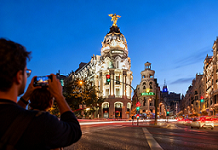
Discovering cities through the images of television series has come about, among other factors, because of the use of urban spaces and their buildings as essential support elements in fictional narrative. Places and settings that are more or less well-known, emblematic, or anonymous scenes in which individuals are diluted in locations that are easily recognizable and assimilated in different latitudes. These images, many of which are digitized and are the result of post-production, mark the development and innovation of different audiovisual television formats and their impact on the society of "platform users". They reach the spectator in the form of altered realities in locations and architectural structures that do not always correspond to the original, whether it be their real location or their real functions. This is what happens in Money Heist (Álex Pina, Netflix: 2017-2021) with the CSIC building, the Nuevos Ministerios building and other locations that are studied in this article. These are representations of elements which create the necessary interconnection and involvement between characters and viewers, and prompt the latter to go see where they are located. This is a visual artifice of cinema and television that enables the illusion of being in altered but somehow identifiable realities, which is why they are familiar and close, that is to say, credible. This is how screen tourism has been created, with tourists choosing their leisure destination based on the places they see in series on digital platforms. The paper’s findings indicate that the series Money Heist reconfigures the image of Madrid, imbuing it with a persona, and makes a significant contribution to the development of innovative experiential tourism. Moreover, the research work unearthed a predominantly favorable attitude amongst viewers towards prior exposure to television series such as Money Heist, which serves to attract visitors to Madrid through motivation and curiosity.
Downloads
Altmetrics
References
Aertsen, V., Gámir, A., & Manuel, C. (2022). Madrid in non-Spanish speaking cinema (1955-2020): film locations and the tourist gaze. Cuadernos de Turismo. https://doi.org/10.6018/turismo.541911
Atresmedia (Productores). (2017-2021). Money Heist series [La casa de papel Serie]. Netflix. https://www.netflix.com
Azorín, F., & Gea, M. I. (1990). La Castellana, escenario de poder. Del Palacio de Linares a la Torre Picasso. Biblioteca Básica de Madrid.
Barrado-Timón, D., Hidalgo-Giralt, C., Palacios-García, A., Ochoa-Ortiz, H., & Sevilla-Callejo, M. (2022). Perception of the filmed urban space: an analysis of the imaginaries of Madrid constructed through series and social networks. Boletín de la Asociación de Geógrafos Españoles. https://doi.org/10.21138/bage.3294
Baudrillard, J. (1997). La ilusión y la desilusión estéticas. Ed. Sala Mebdosza.
Bengesser, C., & Waade, A. (2021). Screen Tourism on the Smartphone: A Typology and Critical Evaluation of the First Decade of Smart Screen Tourism (pp 173–195). In D. Bonelli, & A. Leotta (Eds.). Audiovisual Tourism Promotion. Springer Nature. https://doi.org/10.1007/978-981-16-6410-6_9
Besas, M., & Besas, P. (2019). Madrid oculto 2. Ediciones La Librería.
Blanco Vila, L. (1992). Madrid al Paso. Palas Atenea.
Borja, J. (2003). La ciudad conquistada. Alianza.
Chen, P. (2023). Influence of film destination placement on travel intention: mediating effect of involvement and place attachment. International Journal of Tourism Cities. https://doi.org/10.1108/ijtc-05-2022-0132
Clifford, J. (1992) Travelling Cultures. In Grossberg, L., Nelson, C. and Treichler, P. (Eds.) Cultural Studies (pp. 96-116). Routledge.
Connell, J. (2005). Toddlers, tourism and Tobermory: Destination marketing issues and television-induced tourism. Tourism Management, 26, 763-776. https://doi.org/10.1016/J.TOURMAN.2004.04.010
Connell, J., & Meyer, D. (2009). Balamory revisited: An evaluation of the screen tourism destination-tourist nexus. Tourism Management, 30, 194-207. https://doi.org/10.1016/J.TOURMAN.2008.06.001
Cui, X., & Song, Z. (2024). Cultural heritage tourism at film-related tourism sites: staged and existential authenticity at Hengdian World Studios. Journal of Heritage Tourism, 19, 559 - 576. https://doi.org/10.1080/1743873X.2024.2346505
Depken, C., Globan, T., & Kožić, I. (2020). Television-Induced Tourism: Evidence from Croatia. Atlantic Economic Journal, 48, 253–262 https://link.springer.com/article/10.1007/s11293-020-09673-3
Domínguez-Azcue, J., Almeida-García, F., Pérez-Tapia, G., & Cestino-González, E. (2021). The impact of Netflix series on destination image and tourism intention: The case of "Cable Girls" and Madrid. International Journal of Tourism Research, 23(5), 665-678.
Du, Y., Li, J., Pan, B., & Zhang, Y. (2020). Lost in Thailand: A case study on the impact of a film on tourist behavior. Journal of Vacation Marketing, 26, 365-377. https://doi.org/10.1177/1356766719886902
Edgerton, G. (2022). Netflix, Spanish television, and La casa de papel: Growing global and local TV together in the multiplatform era. Critical Studies in Television, 18, 128-147. https://doi.org/10.1177/17496020221146057
Eisner, E. (1992). La incomprendida función de las artes en el desarrollo humano. Revista española de pedagogía.
Exceltur. (2022). Barómetro de la Rentabilidad de los destinos turísticos españoles. https://tinyurl.com/2vmhs633
Gallego, J. (2001). Introducción a la teoría de la imagen. Pirámide.
Gardner, H. (2019). Multiple intelligences. Theory in practice. Fondo de cultura económica.
Gerbner, G. (1998). Cultivation Analysis: An overview. Mass Communication & Society, 1(3- 4), 175-194. https://doi.org/10.1080/15205436.1998.9677855
Goleman, D. (1996). Inteligencia emocional. Kairós.
Hellín P. A., & Martínez, S. (2009). Marca turística y movie maps. Identidad, cine y publicidad como producto de consumo. Revista Signos de Consumo, 2.
Iwashita, C. (2008). Roles of Films and Television Dramas in International Tourism: The Case of Japanese Tourists to the UK. Journal of Travel & Tourism Marketing, 24, 139 - 151. https://doi.org/10.1080/10548400802092635
Jones, B. (2025). The Power of that Fan Base is Really Strong, and it’s Something we are Encouraging Tourism Businesses to See: The Economic, Individual, and Civic Values of Fan-Created Screen Tourism Content. The Velvet Light Trap, 95, 39-50. https://doi.org/10.1353/vlt.00006
Kendall, G., Chan, J., Yeung, M., & Law, K. (2020). Do film festivals attract tourists? Current Issues in Tourism, 24, 1482 - 1486. https://doi.org/10.1080/13683500.2020.1758041
Kim, S. (2010). Extraordinary Experience: Re-enacting and Photographing at Screen Tourism Locations. Tourism and Hospitality Planning & Development, 7, 59-75. https://doi.org/10.1080/14790530903522630
Kim, S., & O'Connor, N. (2011). A cross‐cultural study of screen‐tourists' profiles. Worldwide Hospitality and Tourism Themes, 3, 141-158. https://doi.org/10.1108/17554211111123005
Kim, S., & Wang, H. (2012). From television to the film set. International Communication Gazette, 74, 423 - 442. https://doi.org/10.1177/1748048512445152
López L., & Nicolás, M. T. (2015). El análisis de series de televisión: construcción de un modelo interdisciplinario. Entornos Audiovisuales. ComHumanitas: Revista científica de Comunicación, 6 (1), 22-39. https://doi.org/10.31207/rch.v6i1.66
Madrid Film Office. (2002). Madrid a través de las series. https://www.esmadrid.com/sites/default/files/folleto_madrid_a_traves_de_las_series.pdf
Martínez-Sala, A. M., Monserrat-Gauchi, J., & Segarra-Saavedra, J. (2019). El influencer 2.0 turístico: de turista anónimo a líder de opinión. Revista Latina de Comunicación Social, (74), 1344-1365.
Morgan, M., Shanahan, S. y Signorielli, N. (2009). Growing up with television: cultivation processes. En J. Bryant y M. B. Oliver. (Eds.). Media effects. Advances in theory and research (pp. 34-49). Routledge.
Noya, J. (2003). Cultura, desigualdad y reflexibilidad: la sociología de Pierre Bourdieu. Catarata.
Salovey, P., & Mayer, J. D. (1990). Emotional intelligence. Imagination, Cognition, and Personality. 9(3), 185–211. https://doi.org/10.2190/DUGG-P24E-52WK-6CDG
Soto Fernández, G (2023). La era del consumo en la esfera audiovisual: series y plataformas streaming. SERIARTE. Revista Científica de Series Televisivas y Arte Audiovisual, 3. http:// doi.org/10.21071/seriarte.v3i.15199
Ortega Cantero, N. (1988). Geografía y cultura. Alianza Universidad.
Ortega Cantero, N. (2006). Ver, pensar, sentir el paisaje. Expresiones literarias del paisaje moderno, en Imágenes del paisaje. Fundación Duques de Soria y Universidad Autónoma de Madrid.
Oviedo-García, M., Castellanos-Verdugo, M., Trujillo-García, A., & Mallya, T. (2016). Film-induced tourist motivations. The case of Seville (Spain). Current Issues in Tourism, 19, 713 - 733. https://doi.org/10.1080/13683500.2013.872606
Parramon, P., & Medina, F. (2017). Are the big tv productions a culture-based tourism attraction? perceptions related to the case of Game of Thrones in Girona. International journal of scientific management and tourism, 3, 403-420.
Pereira-Villazón, T., & Portilla, I. (2020). La gestión de la marca del programa frente a la marca corporativa en redes sociales. Caso: La Casa de Papel. Estudios Sobre El Mensaje Periodístico, 26, 1543-1553. https://doi.org/10.5209/esmp.67807
Puche-Ruiz, M., & Gámir, A. (2023). Audiovisual Fiction and World Heritage Sites in Medium-Sized Spanish Cities: The Alhambra of Granada and the Royal Alcazar of Seville (1905–2023). Sustainability. https://doi.org/10.3390/su15097402
PWC. Technique report. Entertainment and Media Outlook 2018-2022 España. https://tinyurl.com/52z7ce88
Qutub, A., Marie, D., Meer, S., & Alkurdi, A. (2021). Netflix and Crime: Identification with the Characters of ‘La Casa de Papel’ Spanish Series. IAFOR Journal of Arts & Humanities. https://doi.org/10.22492/ijah.8.1.01.
Shi, Y. (2005). Editor’s Introduction. Journal of Communication Inquiry, 29, 191 - 194. https://doi.org/10.1177/0196859905276138
Stake, R. E. (1995). The art of study case research. Sage.
Tkalec, M., Žilić, I., & Recher, V. (2017). The effect of film industry on tourism: Game of Thrones and Dubrovnik. International Journal of Tourism Research, 19, 705-714. https://doi.org/10.1002/JTR.2142
Tooke, N., & Baker, M. (1996). Seeing is believing: the effect of film on visitor numbers to screened locations. Tourism Management, 17, 87-94. https://doi.org/10.1016/0261-5177(95)00111-5
Vancouvermedia (2022).Vancouver Media y las cifras detrás de La Casa de Papel https://vancouvermedia.es/
Vargas, J. (2019). Storytelling Mindfulness: storytelling program for meditations. https://tinyurl.com/mvd7sw7p
Vila, N., Brea, J., & Carlos, P. (2021). Film tourism in Spain: Destination awareness and visit motivation as determinants to visit places seen in TV series. European Research on Management and Business Economics, 27, 100135. https://doi.org/10.1016/j.iedeen.2020.100135
Villafañe Gallego, J. (2001). Introducción a la teoría de la imagen. Pirámide.
Wen, H., Josiam, B., Spears, D., & Yang, Y. (2018). Influence of movies and television on Chinese Tourists perception toward international tourism destinations. Tourism Management Perspectives. https://doi.org/10.1016/J.TMP.2018.09.006
Yao, R., & Yang, J. (2024). Exploring the appeal of villainous characters in film-induced tourism: perceived charismatic leadership and justice sensitivity. Humanities and Social Sciences Communications, 11, 1-17. https://doi.org/10.1057/s41599-024-02747-6
Yang, Q. (2020). The Influence of Film and Television IP on Tourism Destination Image Perceived by Tourists. Taking the Shooting Location of “The Untamed” Duyun, Guizhou as an Example. Proceedings of the 2020 International Conference on Management, Economy and Law (ICMEL 2020) https://doi.org/10.2991/aebmr.k.201111.027
Zhou, B., Xiong, Q., Li, P., Liu, S., Wang, L., & Ryan, C. (2023). Celebrity and film tourist loyalty: Destination image and place attachment as mediators. Journal of Hospitality and Tourism Management. https://doi.org/10.1016/j.jhtm.2022.11.004
Copyright (c) 2025 Pilar Yébenes Cortés, José Jesús Vargas Delgado

This work is licensed under a Creative Commons Attribution 4.0 International License.
By submitting a proposal, the author agrees to the following terms:
- a) The author retains the authorship rights, granting the journal the right of first publication of the work.
- b) The texts will be disseminated with the Creative attribution license Commons 4.0. BY that allows you to share, copy and redistribute the material in any medium or format, as well as adapt, remix, transform and build on the material for any purpose, including commercially.


